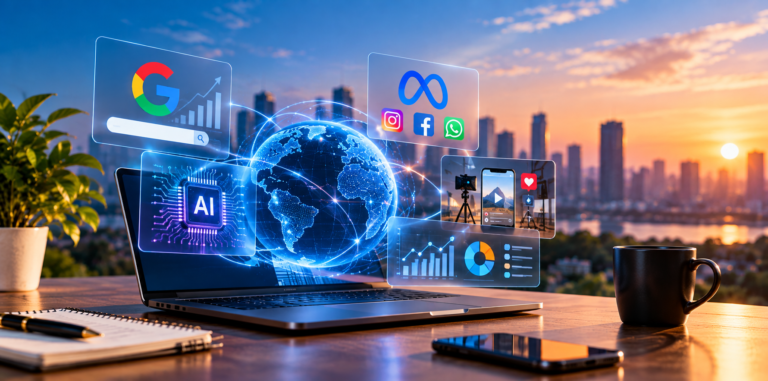
Meta's expansion of Muse connects AI with commerce, accounting, design and social tools used by small businesses.
October 1, 2026 — Meta is moving its artificial-intelligence strategy deeper into small-business operations, with its Muse agent now connected to commerce, design, accounting, communication and marketing tools.
The development represents a change from AI as a standalone assistant toward AI as a layer that can work with the software a business already uses.
Muse is designed around business goals
Meta introduced Muse as a personal AI agent in September and subsequently expanded it for small businesses. Instead of limiting the product to question answering, Meta says users can give Muse goals such as running a business or finding new customers.
The system can then work across connected applications to gather information and prepare tasks. Meta says users maintain control and that publishing, sending and spending require approval. citeturn0search0turn0search2
The connector strategy is the important part
Muse can connect with tools including Shopify, Canva, QuickBooks, Klaviyo, Notion, Slack, Stripe, Asana, Dropbox and business accounts on Facebook and Instagram.
These integrations matter because business information is usually fragmented. Sales may live in an ecommerce platform, customer communication in email or messaging, financial information in accounting software and creative assets in a design application.
AI can work with existing context
Meta says Muse can use connected business information to understand what a company sells, how its brand communicates and what customers are asking about. That context can make AI assistance more specific than a generic chatbot.
For example, a small business owner could ask the system to analyse sales and campaigns and prepare a growth plan, or review financial information for unusual expenses. These are examples of the type of workflow Meta is promoting rather than guarantees of business results. citeturn0search0
Marketing and operations are converging
Traditionally, marketing software and business operations software were treated as separate categories. The marketing team managed campaigns while finance handled accounting and operations handled internal workflows.
An AI agent can potentially connect these areas. A campaign recommendation can take sales performance into account, while customer questions can be linked to product information and inventory.
Approval remains important
Meta’s decision to emphasize user approval is significant. An AI system can analyse information and prepare work without necessarily being allowed to take the final action.
That distinction provides a practical control layer for small businesses that may not have dedicated IT or risk teams. It also makes it easier for owners to adopt automation gradually.
Small businesses have a different AI need
Large companies can purchase specialised software and employ teams to operate it. Small businesses often need one person to manage marketing, sales, customer service, finance and administration.
AI agents are particularly relevant in that environment because their potential value comes from reducing coordination work rather than replacing a single specialist application.
Privacy and access need attention
Connecting more applications also means giving an AI system access to more information. Businesses should understand what data is available to the agent, what actions it can perform and how permissions can be revoked.
Security should therefore be treated as part of the workflow design rather than something added after deployment.
Meta’s broader AI strategy
Muse is part of Meta’s broader push into personal and business AI. The company is attempting to make AI useful across its existing ecosystem rather than relying only on a standalone chatbot.
The long-term significance will depend on whether businesses continue using connected agents after the initial experimentation phase and whether the systems can demonstrate reliable value.
What comes next
Meta says it plans to add more connectors and skills. That could make Muse increasingly relevant to businesses that already depend on several cloud applications.
For small businesses, the emerging model is straightforward: AI becomes most useful when it can understand the business context and assist across the tools that already run the business.
Sources