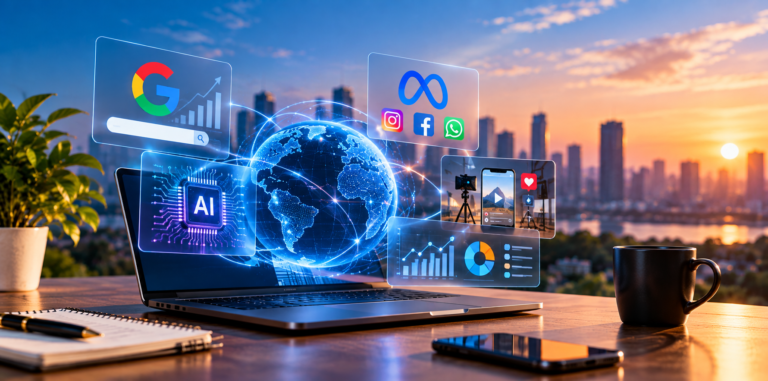
The latest AI launches from major technology companies show autonomous agents moving into marketing, productivity and enterprise workflows.
October 1, 2026 — AI agents are moving from experimental demonstrations toward practical business workflows as technology companies increasingly connect AI systems to the applications where employees already work.
The shift is important because an AI assistant that only generates text has a different business value from an agent that can retrieve information, coordinate tasks, prepare work and interact with connected software under human approval.
From chatbots to workflow systems
The first wave of business AI focused heavily on conversational interfaces and content generation. Companies used AI to draft emails, summarize meetings, create marketing copy and answer questions.
The newer agent model adds tools and context. An agent can potentially work with customer records, documents, project-management systems, finance software or communication platforms instead of operating only inside a chat window.
Meta’s Muse illustrates the direction
Meta’s Muse for Small Business is an example of this transition. Meta says Muse can connect to services such as Shopify, Canva, QuickBooks, Slack, Stripe and Notion, allowing it to work with business information across multiple applications.
The company has positioned Muse around business goals rather than isolated prompts. Importantly, Meta says actions such as publishing, sending or spending require user approval.
Why integrations matter
An AI system becomes more useful when it has access to the information required to complete a task. A marketing assistant without access to campaign data can suggest ideas, but an agent connected to campaign performance, customer information and creative tools can potentially prepare a much more specific workflow.
This is why software integrations are becoming a competitive part of the AI market. The quality of the underlying data and the permissions available to the agent can determine what it is actually capable of doing.
Approval and security become critical
Giving AI access to business systems creates new risks. An incorrect answer in a chat is one problem; an incorrect action in a financial, advertising or customer system can have direct consequences.
Businesses therefore need clear approval rules, access controls, audit trails and limits on what agents can do without human confirmation.
Small businesses could benefit significantly
Large companies can employ specialists for marketing, finance, customer support and operations. Small businesses often rely on a few people to handle several functions.
Agents could help reduce the administrative burden by connecting those functions. A business owner might use an agent to summarize sales information, prepare marketing tasks and organize customer follow-up rather than manually moving information between applications.
But automation does not remove the need for process design
An agent cannot compensate for a poorly designed workflow indefinitely. If customer data is incomplete, conversion events are incorrectly configured or responsibilities are unclear, AI can reproduce those weaknesses at greater speed.
Businesses adopting agents therefore need to define the desired outcome, the information the system can access, the actions it can take and the points at which a person must review its work.
The next phase of enterprise AI
The competition between technology platforms is increasingly shifting toward who can provide the best combination of models, integrations, data access, security and workflow controls.
For companies, the practical question is becoming less about whether they have an AI chatbot and more about which repetitive processes can safely be supported by an AI agent.
What to watch
During the remainder of 2026, businesses should watch for deeper integrations, more granular permissions, stronger audit features and clearer measurement of agent performance.
The move toward agents does not make human oversight irrelevant. Instead, it makes the design of human oversight one of the central parts of deploying AI responsibly in everyday business operations.
Sources