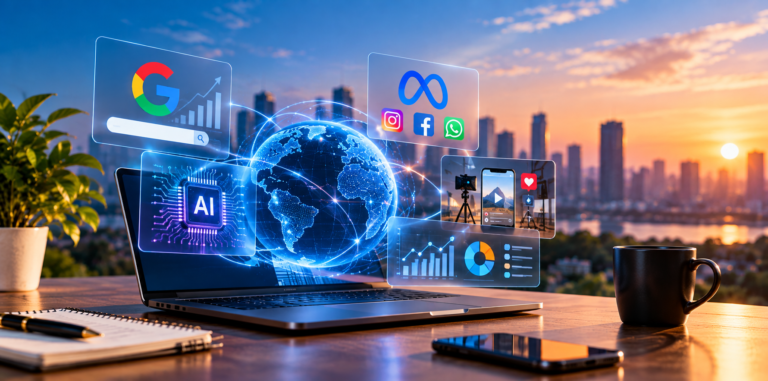
Recent platform launches show AI moving from content-generation assistance toward connected marketing workflows.
October 1, 2026 — Digital marketing is entering a new stage in which artificial intelligence is being used not only to create content, but also to coordinate research, campaign preparation, measurement and day-to-day execution.
Recent product announcements from Google, Meta and other technology companies show a common direction: AI is becoming embedded in the workflow itself. For marketers, that means the technology conversation is moving from “What can AI generate?” to “Which parts of the marketing process can AI safely operate?”
Content generation is no longer the whole story
The first mainstream wave of generative AI in marketing focused heavily on writing copy, generating images and producing variations of existing content. These capabilities remain useful, but they are becoming increasingly common across competing platforms.
The next competitive layer is workflow automation. An AI system that can understand a campaign objective, examine available information, prepare assets, identify relevant audiences and produce a measurement summary can potentially save more time than a tool that only produces a paragraph of copy.
Google is automating more of paid search
Google’s AI Max for Search campaigns illustrates this transition. The system can expand the ways search campaigns match with user intent, customize text and help select landing pages.
Google has also been expanding reporting so advertisers can understand the relationship between search terms, creative assets and landing pages. The combination is significant: automation without measurement can reduce visibility, while automation paired with stronger reporting can give marketers a way to evaluate the system’s decisions.
Meta is building AI around business goals
Meta’s Muse for Small Business takes another approach. Meta says the product can connect to business applications including Shopify, Canva, QuickBooks, Slack, Stripe and Notion.
The purpose is not simply to answer a question. Muse is designed around business goals and can use connected information to help with tasks. Meta says users remain in control and that actions such as publishing, sending or spending require approval.
Measurement becomes more important
Automation increases the importance of accurate measurement. If an advertising platform is allowed to make more decisions automatically, the conversion signals it receives become even more influential.
Google’s recent measurement work has focused on improving the quality of business signals available to advertisers. This includes greater emphasis on first-party data and measurement systems designed to connect advertising activity with outcomes.
The role of marketers is changing
AI can reduce the time required for repetitive tasks, but marketing still involves decisions that depend on business context. Positioning, pricing, brand strategy, customer experience and creative direction cannot be reduced to simply generating more output.
Marketing teams may therefore spend less time manually producing every variation and more time defining objectives, reviewing AI-generated work and deciding which signals should guide automated systems.
Small businesses may see the biggest workflow gains
A large enterprise can have dedicated teams for performance marketing, design, analytics and customer operations. A small business may have one or two people performing all of those functions.
AI agents could allow smaller teams to coordinate more work without adding the same amount of administrative overhead. The value will depend on integrations, data quality and the ability to maintain human approval for important decisions.
Risks move with the automation
When AI becomes part of execution, errors can travel further. Incorrect information can be reused across campaigns, a poorly configured conversion event can influence optimization, and excessive permissions can create operational or privacy risks.
Businesses therefore need clear access controls, approval processes and monitoring. The objective should not be maximum automation; it should be reliable automation for tasks where the business understands the risks.
What marketers should watch next
The next phase of digital marketing AI will likely be defined by deeper platform integrations, agent-based workflows and more detailed reporting. The companies that benefit most may not simply be those generating the most content, but those using AI to reduce friction between data, decisions and execution.
For marketing teams, the practical priority is to identify repetitive processes, improve the underlying data and introduce AI where the outcome can be measured clearly.
Sources