

Meta’s Muse expansion connects AI with social, commerce, finance and productivity tools, bringing agent-based business workflows to small businesses.
Meta is expanding AI from content assistance into day-to-day business operations with Muse, an agent designed to work across social platforms and business software. The company’s September 2026 expansion gives small businesses a way to connect tools such as Instagram, Facebook, Shopify, Canva, Slack, Stripe and QuickBooks so an AI agent can work with more of the context required to run a business.
From chatbot to business agent
The important distinction is that Muse is designed around goals and tasks rather than isolated questions. Meta says a small business can give Muse a goal such as running parts of the business or finding new customers, then connect the services it already uses.
That approach reflects a broader shift in business AI. Earlier generations of assistants primarily generated text, answered questions or summarized information. Agent-based systems are increasingly being designed to inspect information, propose actions and coordinate work across applications.
Connecting the business stack
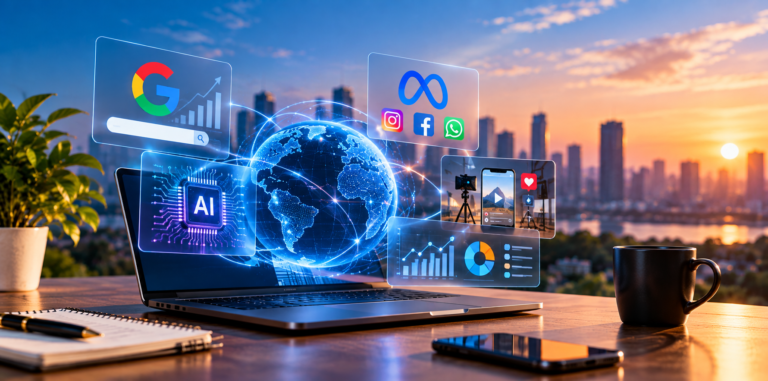
Meta says Muse can connect to Facebook Pages, Instagram professional account analytics and Meta advertising accounts. It can also connect with services including Asana, Box, Canva, Dropbox, Figma, Granola, HighLevel, Intuit QuickBooks, Klaviyo, Lovable, Notion, Shopify, Slack, Stripe and Zoom.
For a small business, this matters because information is usually distributed across multiple systems. Marketing performance may live in Meta Ads, customer conversations in Instagram or WhatsApp, inventory in Shopify, accounting in QuickBooks and creative assets in Canva. Connecting those systems gives an agent more context than a standalone chatbot has.
Examples of practical use
Meta has demonstrated workflows in which Muse can analyze business information, identify issues and prepare work for approval. A business owner could ask it to review advertising and content performance, identify what is working, and prepare a campaign for the following week. Another workflow can review financial performance and flag unusual expenses.
The value of these workflows is not necessarily that AI replaces an employee. Instead, the system can reduce the amount of time spent collecting information, switching between applications and preparing first drafts.
Approval remains part of the workflow
Meta emphasizes that connected automation does not mean unlimited autonomous access. According to the company, nothing publishes, sends or spends without the user’s approval. That approval layer is important because business actions can have financial, reputational and customer-service consequences.
For businesses adopting agents, permission design is likely to become as important as model quality. The practical question is not simply whether an AI system can perform a task, but which tasks it can perform automatically, which require review and which should remain completely human-controlled.
Why this matters for marketing teams
Muse connects several activities that are often managed separately: content creation, analytics, customer communication, advertising and business operations. This could make marketing more continuous. Instead of producing a monthly report and manually deciding what to do next, an agent can potentially monitor signals and prepare actions as new information arrives.
That also raises the importance of clean data. If an agent receives incomplete product information, inaccurate financial records or poorly configured advertising data, automation can accelerate the wrong decision. Businesses therefore need clear data sources, permissions and review processes.
The wider AI-agent trend
Meta’s move is part of a wider technology-industry shift toward AI agents that connect multiple tools. Meta has separately introduced Business Agent capabilities for customer conversations and has now positioned Muse as a more general-purpose system for small-business work.
The strategic direction is clear: AI is increasingly being positioned not only as a content generator but as an operating layer between a business owner and the software stack.
What businesses should watch
The practical test will be whether connected agents save meaningful time without creating new risks. Small businesses will need to consider data access, approval workflows, accuracy, privacy, cost and the consequences of automated actions.
For now, Meta’s announcement shows how quickly business AI is moving from individual prompts toward connected workflows. As more connectors and skills are added, the competitive question may become how effectively a business can organize its information and processes for AI-assisted execution.



One thought on “Meta Introduces Muse for Small Businesses With AI Agents and Business Connectors”