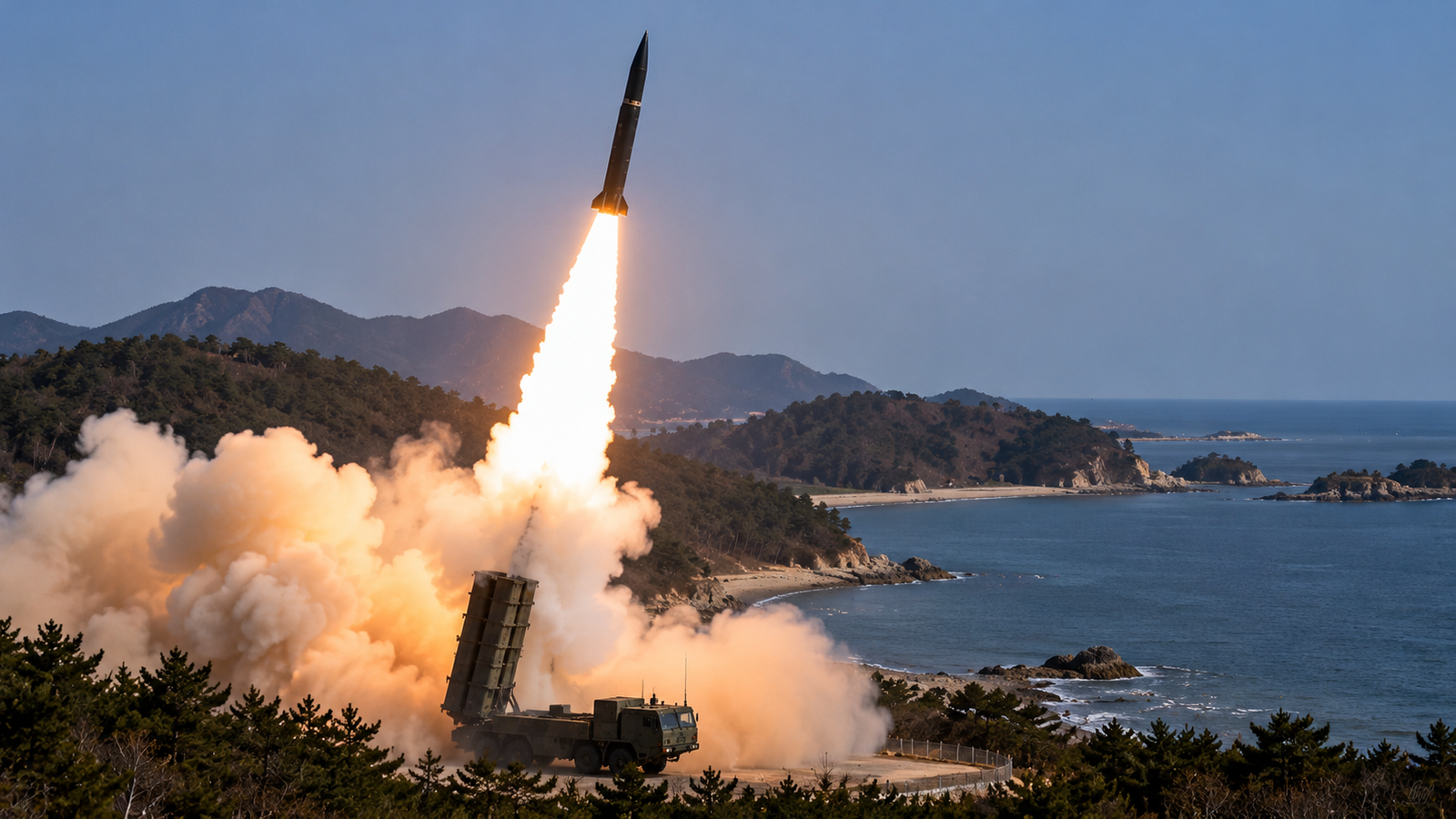
South Korea said North Korea launched multiple ballistic missiles toward the East Sea, with at least one travelling more than 900 kilometres, days after a South Korean hypersonic test.
October 12, 2026
North Korea fired multiple ballistic missiles toward the East Sea on Monday, South Korea’s military said, in the latest exchange of military signalling between the two Koreas. South Korea’s Joint Chiefs of Staff said the launches were detected from the Pyongyang area at about 9:20 a.m. local time. One missile travelled more than 900 kilometres, according to Yonhap News Agency.
Reuters reported that Japan also detected projectiles and that the launches followed South Korea’s recent test of a hypersonic missile. Seoul condemned the launches as violations of United Nations Security Council resolutions and said it was maintaining readiness while sharing information with the United States and Japan.
Why the timing matters
The launches came amid heightened military tension on the Korean Peninsula and follow a series of North Korean missile tests. Missile launches are used by Pyongyang to test weapons systems, signal deterrence and respond politically to exercises or capabilities demonstrated by South Korea and its partners. The precise technical characteristics and intended message of each launch require assessment by military and intelligence authorities.
South Korea’s hypersonic test and North Korea’s response illustrate how weapons demonstrations can contribute to a cycle of signalling. However, the sequence alone does not establish that the South Korean test was the sole cause of the North Korean launches. Pyongyang has its own weapons-development programme and broader strategic objectives.
Regional and international implications
Ballistic missile launches by North Korea have repeatedly drawn criticism from Seoul, Tokyo and Washington. Security Council resolutions restrict North Korea’s ballistic missile activities, although enforcement and diplomatic responses remain complicated by wider geopolitical divisions.
For neighbouring countries, the immediate priorities are tracking potential flight paths, assessing whether any projectiles pose a threat, and maintaining communication between defence authorities. There was no indication in the cited reports that the missiles struck populated areas; officials’ assessments may provide further details.
What to watch
- Further information from South Korea’s Joint Chiefs of Staff and Japan’s defence authorities.
- Any additional launches or military exercises in the region.
- Responses from the United States, South Korea, Japan and the United Nations.
Sources
- Reuters: North Korea fires projectiles toward the sea off its east coast
- Yonhap News Agency: North Korea fires multiple ballistic missiles toward the East Sea
Reporting note: This report reflects information available on October 12, 2026. Missile counts, flight details and official assessments may be revised as more information is released.